Posts

Showing posts from December, 2023

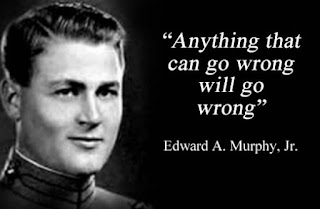
Murphy's Law: Expect the Unexpected

Image
  Have you ever heard of Murphy's Law? What is Murphy's Law? It's a principle that states, "Anything that can go wrong will go wrong." This law, also known as Murphy's Principle or Murphy's Rule, highlights the tendency of things to go awry and cause problems. Understanding Murphy's Law can help us prepare for potential setbacks and approach them with a proactive mindset. In this blog post, we'll explore the essence of Murphy's Law and its significance in various fields. The Origin of Murphy's Law: Murphy's Law finds its roots in the work of an American aerospace engineer named Edward Murphy. During the 1950s, Murphy discovered that errors in technical designs often occurred due to the neglect or oversight of potential failure factors. This realization led to the formulation of what we now know as Murphy's Law. At its core, Murphy's Law suggests that if something has the potential to go wrong, it will undoubtedly go wrong at som...

Python : Generate Fake Data

Image
Generating Fake Data using Python and Faker Library Fake Data with Python Code Explanation and Usage: The provided code showcases how to generate fake data using Python and the Faker library. Here's a breakdown of the code and its usage: 1- Importing Dependencies: The code begins by importing the necessary modules: csv and Faker. The csv module is used to handle CSV file operations, while the Faker module is responsible for generating fake data. 2- Initializing Faker and Data List: The code creates an instance of the Faker class and initializes an empty list called data. This list will store the generated fake data to use it later in the file that we will create. 3- Generating Fake Data: A for loop is used to iterate "n" times, generating fake data for each iteration. The generated data is stored as a dictionary with keys representing the headers ('Name', 'Date of Birth', 'Email', 'Phone Number', 'Address') and values generated by ...

python | What is a for Loop?

Image
  Wider look over for Loops in Python for loop What are for Loops in Python? For loops allow you to iterate over a sequence of values. For example: for x in range(5):     print(x) outout: 0 1 2 3 4 Try it yourself Similar to if statements and while loops, for loops begin with the keyword for with a colon at the end of the line. Just like in function definitions, while loops and if statements, the body of the for loop begins on the next line and is indented to the right. But what about the stuff in between the for keyword and the colon? In our example, we’re using the range() function to create a sequence of numbers that our for loop can iterate over. In this case, our variable x points to the current element in the sequence as the for loop iterates over the sequence of numbers Keep in mind that in Python and many programming languages, a range of numbers will start at 0 , and the list of numbers generated will be one less than the provided value. So range(5) ...