Posts

Showing posts from November, 2020

250 Phrases to Use at Work

Image
The Executive Playbook: 250 Essential Phrases for Workplace Success 250 Phrases to Use at Work Whether you are leading a team meeting, resolving a high-stakes conflict, or simply trying to build rapport with a new colleague, your vocabulary defines your professional brand. Mastering these nuanced phrases will help you navigate the complexities of corporate life with confidence and grace. Mastering Key Professional Scenarios 1. Navigating Conflict & Disagreement Disagreeing with a stakeholder doesn't have to be confrontational. By using "buffer phrases," you can acknowledge their perspective while pivoting to your own. The Approach: Instead of a blunt "I disagree," try "I see your point, however..." or "I have a slightly different perspective on this." Conflict Resolution: When tensions rise, use de-escalation language like "Let’s try to find a middle ground" or "I understand your frustration, let’s look at the facts." ...

Save your Vocabulary on Google Translate

Image
 How to Save your Vocabulary on Google Translate Vocabulary is like your coins when it comes to language learning. The more coins you have, the richer your language is. Almost all of us use Google translate when we deal with languages or language learning. But, is there a way to store the new words that we searched for on Google translate? Good new is, yes there is. Here's how: Make sure to have a google account and sign in before opening Google Translate Choose the language and the target language Choose the language Write the word on the left side for which you want to search for the meaning On the right side, you will have the translation based on the language you chose on step 2 On the right side - beside the meaning - you will find a white star ✰, press on it (Star Translation) The star color will change to yellow ⭐. This means your word has been "Saved" Star Translation - Save the word) Go down to the bottom of the page and you will find 3 options (History, Saved, C...

44 Grammar Confusions - Part 2 of 2

Image
44 Grammar Confusions - Part 2 of 2 44 Grammar Confusions Welcome back to the second part of our series on common grammar confusions. In this post, we'll delve into more pairs of words that often trip people up. Understanding these distinctions can help you communicate more clearly and avoid annoying the grammar police! Main Confusions: 23. Incredible vs. Incredulous Incredible : While originally meaning unbelievable, over time, it has come to signify something especially good. Incredulous : This word has a more negative connotation; it means skeptical. 24. Infectious vs. Contagious Infectious : Something that is infectious may or may not be contagious because infectious refers to cause. Contagious : Something that is contagious is spread by contact, nearly direct physical contact, and contagious refers to possibility of transmission. 25. It's vs. Its It's : A common contraction of "it is" or "it has." Its : The possessive form of it. Use its if replacin...

44 Grammar Confusions - Part 1 of 2

Image
 44 Grammar Confusions - Part 1 of 2 44 Grammar Confusions - Part 1 of 2 List of Confusions: Advance vs Advanced Affecet vs Effect Altogether vs All Together Amount vs Number Amused vs Bemused Apart vs A Part Appraise vs Apprise Breath vs Breathe Breach vs Breech Bring vs Take Depreciate vs Deprecate Deserts n. v. vs Desserts Diffuse vs Defuse Disinterested vs Uninterested e.g. vs i.e. Economic vd Economical Emigrate vs Immigrate Flaunt vs Flout Grisly vs Grizzlly vs Grizzled Home in vs Hone in Hord vd Hoard And now, let's dive in 🏊‍♂️ 📌 The pronunciation symbols used are in American English using the International Phonetic Alphabet (IPA) Advance vs Advanced Advance: /ədˈvæns/ - (verb) to move forward, make progress, or pay or lend money before it is due. Example: He advanced his career by taking on new responsibilities. Advanced: /ədˈvænst/ - (adjective) more highly developed or skilled; at a higher level. Example: She took an advanced course in mathematics. Affect vs. Effe...

British vs. American English

Image
British and American English American English or British English History of the Differences The British actually introduced the language to the Americas when they reached these lands by sea between the 16th and 17th centuries. At that time, spelling had not yet been standardized. It took the writing of the first dictionaries to set in stone how these words appeared. In the UK, the dictionary was compiled by London-based scholars. Meanwhile, in the United States, the lexicographer was a man named Noah Webster. Allegedly, he changed how the words were spelled to make the American version different from the British as a way of showing cultural independence from its mother country. In terms of speech, the differences between American and British English actually took place after the first settlers arrived in America. These groups of people spoke using what was called rhotic speech, where the ‘r’ sounds of words are pronounced. Meanwhile, the higher classes in the UK wanted to distinguish ...

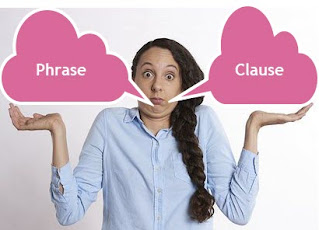
A Phrase vs A Clause

Image
 Difference between Phrases and Clauses a phrase vs a clause First, you need to know that Phrases and clauses are the building blocks (parts) of sentences . So, the structure or hierarchy goes like this: a phrase and a clause are parts of a sentence Let's know the meaning and types of both elements: What is a Phrase? Meaning Examples A word or a group of words in a sentence that does NOT contain a subject and a verb.  after dinner, waiting for the rain to stop, on the wall, in the water, over the horizon. Best friend (this phrase acts as a noun) Needing help (this phrase acts as an adjective With the blue shirt (this prepositional phrase acts as an adjective For twenty days (this prepositional phrase acts as an adverb) the boy on the bus (noun phrase) will be running (verb phrase) in the kitchen (prepositional phrase) very quickly (adverb phrase) Martha and Jan (noun phrase)...